Wow, thanks to the person who pointed out this mistake. It is a serious one!!
In the Polled,Horned and Scurred post, I made a major Mistake under the Scurred description. It is now fixed!!
The mistake was with the Scurred females
A ScSc = Homozygous Animal is SCURRED, not horned as I had written!!
A Scsc = Heterozygous animal is polled
A scsc = Homozygous animal is polled
So again, thank you very much to the person who pointed this out. I know that this will have caused confusion, and I am very sorry for that!!
Randi
Tuesday, January 26, 2010

Tuesday, January 13, 2009
A Spotting Indicator
This one is rather confusing. We have been told that the recessive spotting gene is recessive to the Hereford gene. As a result one would expect that any a recessive spotted animal bred to a hereford animal would result in a bald face calf. This is generally true, however I have noticed a few instances where this does not seem to hold true. Many of you will have noticed the occaisonal hereford marked calf when a hereford parent is bred to a solid colored parent. After watching things in my own herd over the last few years, I have come to the conclusion that for these oddball calves to happen, that solid colored parent must be carrying a copy of the recessive spotting gene.
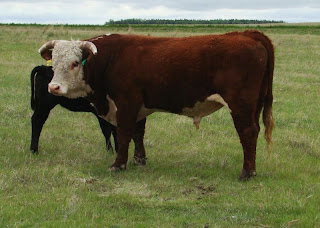
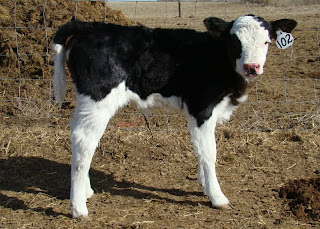
And here we have a ShS (red baldy) cow that when bred to a ss (spotted) Shorthorn
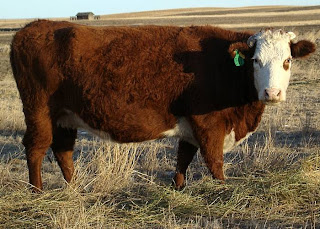 Gave us this calf, with a rather pronounced featherneck and quite a lot of white on her belly and legs.
Here are a few examples......
When this cow 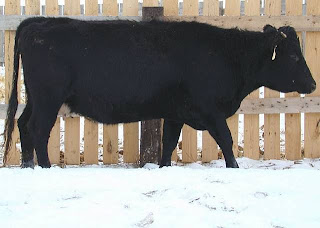
Was bred hereford, we got this calf
A couple years later we bred her to a spotted Shorthorn (ss) bull and got this calf

Which leaves me with the conclusion, that the cow carries the recessive spotting gene (Ss). And that the hereford gene must combine at times with the recessive spotting gene.
This bull is the sire of the next 2 calves, he is ShSh, but exhibits only a very minimal featherneck
Here is another solid cow 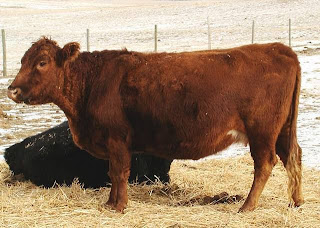 That when bred Hereford will occaisionally throw a calf like this
The featherneck is the main Hereford trait that is lost when an animal is heterozygous rather than homo for Sh, so it really makes me wonder how that cow could have thrown such an extreme featherneck.
Especially considering that the hereford bull that she was bred to exhibits such a minimal featheneck.....
Another calf, this one is out of a ss(spotted) cow bred to an ShSh (hereford)bull
And here we have a ShS (red baldy) cow that when bred to a ss (spotted) Shorthorn
Gave us this calf, with a rather pronounced featherneck and quite a lot of white on her belly and legs.
A darkening factor
The wild type gene, exhibits itself in more than one way. This calf exhibits how a calf can be born one color and then darken as she ages.

As a newborn she looked like a typical red baldy. Notice however, the black markings on her nose. This calf is E+e and ShS
 at about 3 months in age you can already see her darkening. Notice that her nose is nearly completely black now, and you can see darker areas around her tail and neck
and here she is at about 5 months old. She is a much darker red than as a newborn, and you can see even darker areas on her neck, hindquarters and tail.
Sunday, February 24, 2008
Polled, Scurred and Horned
There are 3 different sets of genes that determine whether an animal will be polled, scurred or horned. Two of them can cause horns, and the other causes scurs. One of the horn genes, and the scur gene are both sex-linked, meaning that the genes are linked with the genes that determine the sex of an animal, and they express themselves differently in females than they do in males.
The first gene I will discuss is commonly found in Bos taurus cattle, that is the European and British breeds. This is the Polled gene, P and p. P is polled and p is horned. This gene is NOT sex-linked, and expresses itself in the same way in both male and female animals.
P is dominant, which means that as long as it is present the animal will be polled. PP and Pp animals are both polled in appearance, however Pp animals may pass on either P or p to their offspring. pp animals, are horned in appearance, and will always pass on the p gene to their offspring.
PP = Homozygous - Animal is Polled
Pp = Heterozygous - Animal is Polled
pp = Homozygous - Animal is Horned
The other horn (African horn gene) gene is known in Bos indicus animals, or breeds of Zebu type animals. Brahman animals may carry this gene. This gene IS sex-linked, and expresses iself differently in females than it does in males. It is written as Af and af. In females, Af is recessive, and requires that there be two copies of Af for the animal to be horned. However in males the gene is dominant, and only one copy of the gene is necessary for the trait to express.
In males
AfAf = Homozygous - The animal is Horned
Afaf = Heterozygous - The animal is Horned
afaf = Homozygous - The animal is Polled
In females
AfAf = Homozygous - The animal is Horned
Afaf = Heterozygous - The animal is Polled
afaf = Homozygous - The animal is Polled
A horned female will always give birth to a horned male, however, her female calves may or may not be horned, depending on what gene was passed on from the sire.
The final option for horn like growths is the scurred gene. Scurs are a hornlike growth that are loosely attached to the head. This gene, is thought to work the same way as the Af gene. With the belief that for a male that is heterozygous for the Sc gene to express scurs, he needs to also carry a copy of the p gene. Sc is recessive to the p gene, where a horned animal may be scurred, but they will not be expressed.
So in males
ScSc = Homozygous - Animal is Scurred
Scsc = Heterozygous - Animal is Scurred, although it is believed that HE must also carry a copy of p
scsc = Homozygous - Animal is Polled
In females
ScSc = Homozygous - Animal is SCURRED
Scsc = Heterozygous - Animal is Polled
scsc = Homozygous - Animal is Polled
Again, a Homozygous female should always have a scurred male calf, and her female calves may or may not be scurred, depending on the sire.
In the case of these three genes an animal may possibly carry or even be homozygous for the horn gene, the African horn gene and the scur gene.
The first gene I will discuss is commonly found in Bos taurus cattle, that is the European and British breeds. This is the Polled gene, P and p. P is polled and p is horned. This gene is NOT sex-linked, and expresses itself in the same way in both male and female animals.
P is dominant, which means that as long as it is present the animal will be polled. PP and Pp animals are both polled in appearance, however Pp animals may pass on either P or p to their offspring. pp animals, are horned in appearance, and will always pass on the p gene to their offspring.
PP = Homozygous - Animal is Polled
Pp = Heterozygous - Animal is Polled
pp = Homozygous - Animal is Horned

A homozygous horned animal, in this animal the horns are present. Note the shape of the poll.

Another Homozygous horned animal, this animal has been dehorned, but again notice the shape of the poll.

This animal is heterozygous polled. She carries the horn gene, but since polled is dominant the animal is polled in appearance. Note the shape of the poll.
 And finally, a Homozygous polled animal. Again note the shape of the poll.
As a side note, this gene is one that is known to mutate fairly frequently, which may result in the occaisonal polled animal being born to a horned animal.
The other horn (African horn gene) gene is known in Bos indicus animals, or breeds of Zebu type animals. Brahman animals may carry this gene. This gene IS sex-linked, and expresses iself differently in females than it does in males. It is written as Af and af. In females, Af is recessive, and requires that there be two copies of Af for the animal to be horned. However in males the gene is dominant, and only one copy of the gene is necessary for the trait to express.
In males
AfAf = Homozygous - The animal is Horned
Afaf = Heterozygous - The animal is Horned
afaf = Homozygous - The animal is Polled
In females
AfAf = Homozygous - The animal is Horned
Afaf = Heterozygous - The animal is Polled
afaf = Homozygous - The animal is Polled
A horned female will always give birth to a horned male, however, her female calves may or may not be horned, depending on what gene was passed on from the sire.
The final option for horn like growths is the scurred gene. Scurs are a hornlike growth that are loosely attached to the head. This gene, is thought to work the same way as the Af gene. With the belief that for a male that is heterozygous for the Sc gene to express scurs, he needs to also carry a copy of the p gene. Sc is recessive to the p gene, where a horned animal may be scurred, but they will not be expressed.
So in males
ScSc = Homozygous - Animal is Scurred
Scsc = Heterozygous - Animal is Scurred, although it is believed that HE must also carry a copy of p
scsc = Homozygous - Animal is Polled
In females
ScSc = Homozygous - Animal is SCURRED
Scsc = Heterozygous - Animal is Polled
scsc = Homozygous - Animal is Polled
Again, a Homozygous female should always have a scurred male calf, and her female calves may or may not be scurred, depending on the sire.
In the case of these three genes an animal may possibly carry or even be homozygous for the horn gene, the African horn gene and the scur gene.
Saturday, February 16, 2008
Blazing Along
We come to the Blaze gene. The Blaze gene, Bl, is incompletely dominant, and is common in the Simmental breed.
BlBl animals generally have a large blaze to a white face. Unlike the Sh pattern, they won't have the other associated white areas. BlBl animals with the ss trait for recessive spotting can look a lot like Sh animals.
Blbl animals have less white, usually a blaze, or even as small as a star or a snip.


Here are 2 Blbl animals. As you can see, the black has a full blaze, and the red only has a star and a snip.
Another thing to remember, is that the ss (recessive spots) gene can give very similar results to the Blbl or BlBl.

Here is a calf that very much looks like BlBl or Blbl. However, as both her parents were solid colored, one can presume that they were both Ss blbl in genetic makeup. They both passed on the s gene, to make her ss blbll

Another calf, his parents were ss blbl and Ss blbl. He ended up ss blbl.

This heifer calf is out of 2 Ss blbl parents. Again both parents passed on the s gene, to make the calf ss blbl. This time the calf has only a small amount of white on the head
Brockling, A Mottling of the Facts
The brockling gene Bc is what causes the brockle or mottled faces and legs we often see when we cross Herefords with Angus. There are many breeds that carry this gene, although most spotted breeds, such as Hereford for the most part do not carry it. Normande cattle are one of a few spotted breeds where Bc is common. Bc is dominant, and all it takes is one copy for the trait to be expressed. The amount of brockling is not increased when there are 2 genes present rather than just 1. The Bc affects all white patterns by putting darker colored areas within the white areas, usually on the legs and face. ss animals that carry this gene will often be spotted as normal, but where white is present on their legs they will be mottled.


BcBc and Bcbc animals will express broken patches of color within white spots. They may tie into the colored areas on the animal, or they may be completely separate. If one copy of Bc is present you will see brockling.
This animals is BcBc, she exhibits more color than white, but that is not always the case.


These 3 are all Bcbc animals. The goggles on the last one are more likely due to the Bc gene than any other.
 This animal is also Bcbc, but she exhibits the mottling on her legs also
bcbc animals however will not express the mottling. There are other genes which are thought to cause the goggle eyes in the Hereford and Simmental breeds, so it is possible for a bcbc animal to express similar marking and still be Bc free. There is also thought to be a separate gene that causes the freckle effect sometimes seen within the Hereford breed.


These 3 exhibit the goggle eyes, and are more than likely not due to the Bc gene. As you can see, other than their eyes, they have no other brockling type markings.
Color Sided
Color sided is a common coloration in the Longhorn breed. White Park cattle also exhibit this coloration. Color sided is represented by Cs. Cs is also a incompletely dominant trait. The Homozygous animals will exhibit more than their Heterozygous mates.
CsCs animals are will exhibit a white body, with dark points. The ears, muzzle and lower legs or around the hooves.
Cscs animals however show a varying pattern. Often they will have a white dorsal stripe and white belly with color extending from the head, along the neck and often tapering off as it moves back to the hips. These animals may resemble SpSp animals. The color will often roan or turn splotchy around the edges of the pattern. Animals that carry the Rr and Cscs genes, often will result in an pattern that is very similar to the CsCs individuals.
CsCs animals are will exhibit a white body, with dark points. The ears, muzzle and lower legs or around the hooves.
Cscs animals however show a varying pattern. Often they will have a white dorsal stripe and white belly with color extending from the head, along the neck and often tapering off as it moves back to the hips. These animals may resemble SpSp animals. The color will often roan or turn splotchy around the edges of the pattern. Animals that carry the Rr and Cscs genes, often will result in an pattern that is very similar to the CsCs individuals.

The cow here exhibits the Cscs pattern, however as you can see she did not pass the Cs on to her calf which exhibits cscs.

and, here is her next calf which she passed the gene onto it is Cscs
cscs animals are again solid colored.
Subscribe to:
Posts (Atom)